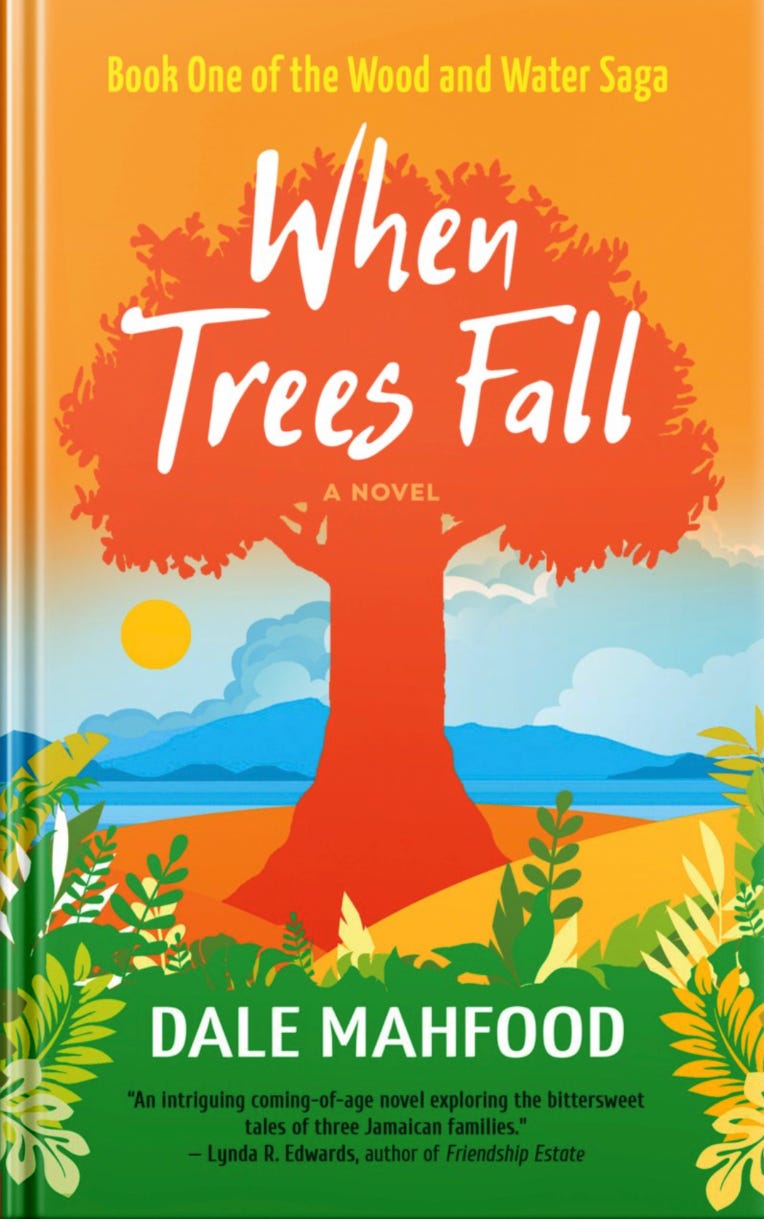
START HERE: When Trees Fall - Important Cultural and Historical Information
Front Matter that Matters

Before I start the chapter-by-chapter posts for When Trees Fall: Book One of the Wood and Water Saga, I’ve chosen to include some of the front matter from the novel to give cultural and historical context to the story.
First, if you haven’t read the book blurb, here it is:
A sweeping family saga exploring secrets we keep and the lines we'll cross for love.
Cailin is a naïve, adventure-seeking girl living in a Jamaican Great House. Archie is a teenage boy with a chip on his shoulder. Sharpe is a young man with divided loyalties, living as an outsider in a poor hillside village. Yet, all three long for the same thing—a father’s approval. But the man who has the power to give it to them won’t…or can’t. Behind his back, his property workers call him a tyrant for allegedly murdering a worker in the past, and his family walks on eggshells when he returns home from his drunken visits with his mistress. All while Cailin, Archie, and Sharp’s unfulfilled desires spiral into rejection, mistaken affections, and murder.
Set in a seaside village during the final year of World War II and Jamaica’s first general election, When Trees Fall is the first novel in Dale Mahfood’s Wood and Water series. If you enjoy well-drawn, relatable characters and a compelling story you don’t want to put down, you’ll love this first installment in Dale Mahfood’s series.
Join Cailin, Archie, and Sharpe for their Caribbean coming-of-age saga.
Now I’d like to share something not written anywhere in the published novel, even though I have shared it publicly during interviews. The seeds for the novel come from stories my mother told me and my family about growing up in the country parts of Jamaica, in the Caribbean, with a terrible father—to say the least. Taking a few of those stories, I've done some reworking to make them into fiction, and included both real people, with their names altered, and completely invented characters with their own story arcs. As it says on the copyright page,
This is a work of fiction. Names, characters, organizations, places, events, and incidents are either products of the author’s imagination or are used fictitiously.
And since we’re on the copyright page, please note the following:
Copyright Ⓒ 2022 by Dale Mahfood, Rockstone Publishing House, LLC, Florida, rockstonepublishinghouse.com
No part of this publication may be altered, reproduced, distributed, or transmitted in any form, by any means, including, but not limited to, scanning, duplicating, uploading, hosting, distributing, or reselling, without the express prior written permission of the publisher, except in the case of reasonable quotations in features such as reviews, interviews, and certain other non-commercial uses currently permitted by copyright law.
The literary works quoted in this novel fall under the Public Domain: Harlem Shadows by Claude McKay, Great Expectations by Charles Dickens, and The Great Gatsby by F. Scott Fitzgerald.
Now on to the context stuff:
Dedication Section:
For Mama, Whose influence on me is profound. Eternal love!
Dear Reader Section:
The Jamaican Language
Even though I am a born-and-raised Jamaican, writing the native Jamaican Language, otherwise known as Patwa, for this novel has been a learning experience. I wrote the Patwa for the first draft phonetically, but most people who read the early manuscript—even many Jamaicans who speak Patwa regularly—said it made for hard reading, interrupting the flow of the story. So, I compromised, using mostly standard English spelling with Patwa grammar. I’ve done my best to keep the flavorful spices of the Jamaican language while still making it readable for a wider audience. As we say in Jamaican, go easy wid me where I have failed. In any case, while I’ve always loved to hear and speak Patwa myself, the experience of “playing” with the language for this novel has been formative in my new conviction that it actually is a language in its own right, with grammar rules, a vocabulary, and rich cadences of speech. It’s also important to note that Patwa is a language that Jamaicans of all social standings can and do speak. I hope you enjoy reading it as much as I enjoyed writing it.
Footnotes
The footnotes in this novel will inform you of some aspects of Jamaican life, culture, and language. They also serve as a subtext for the novel. While they are not necessary to read, those who read them will enhance their experience and understanding of both Jamaica and the novel.
Character List
To assist you in keeping up with the characters in the novel, click here to see the character list. This link will be posted on every chapter post.
Setting
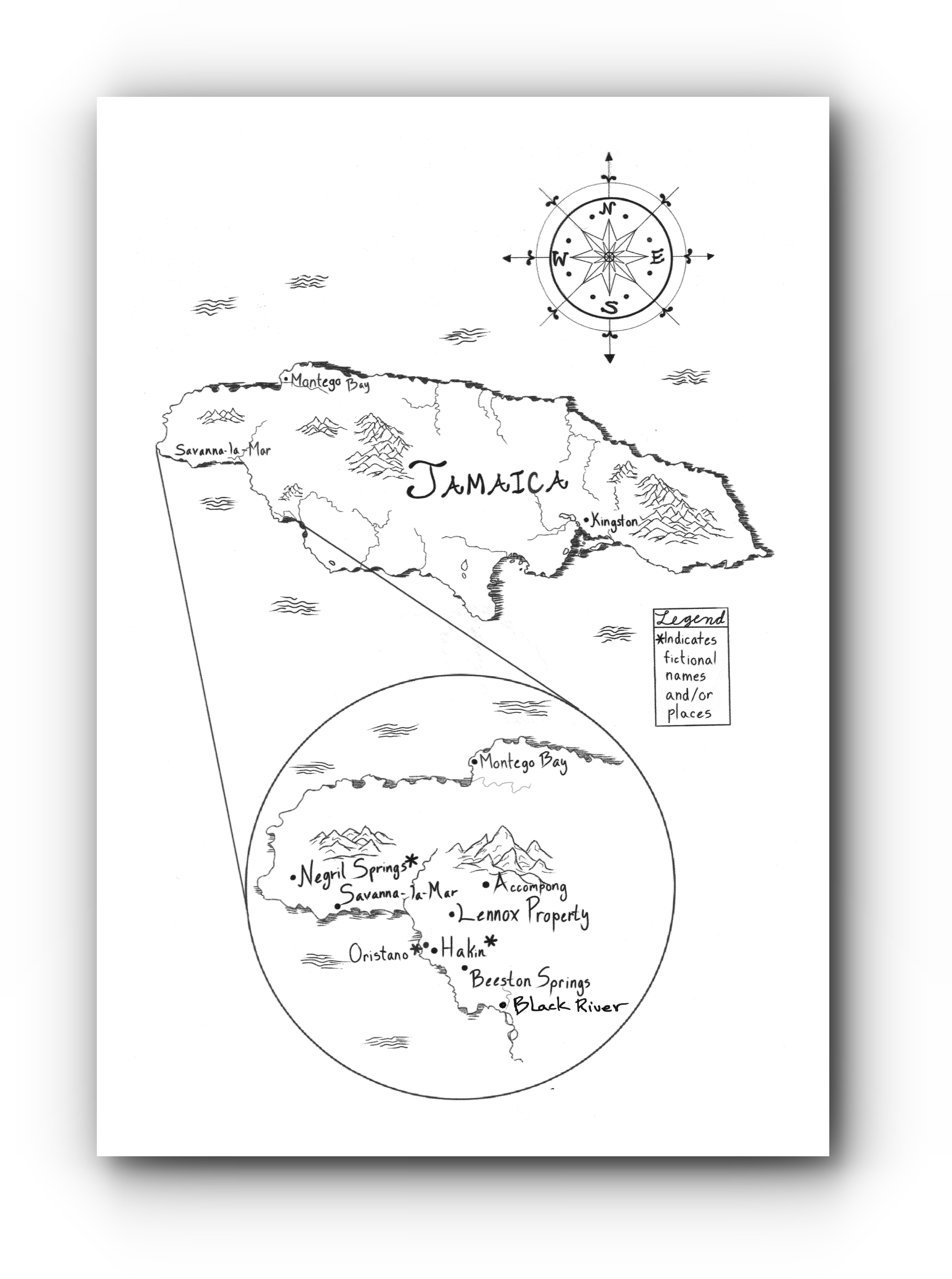
The small village of Oristano, Jamaica, was settled early in the sixteenth century by the Spaniards, who established the settlement on an abandoned Taino1 site. The large bay and abundance of fresh water made it one of the prime sea towns for the Spaniards. Within one hundred and fifty years, the British conquered Jamaica, and, for a time, Oristano became one of their key ports. For the purposes of our story, Oristano is the name of a fishing village in the south-coast parish of Westmoreland.
Map of Jamaica, 1944-1945:
Epigraph Section:
And he cometh to Bethsaida; and they bring a blind man unto him, and besought him to touch him. And he took the blind man by the hand, and led him out of the town; and when he had spit on his eyes, and put his hands upon him, he asked him if he saw ought. And he looked up, and said, I see men as trees, walking. After that he put his hands again upon his eyes, and made him look up: and he was restored, and saw every man clearly.
—Mark 8:22-25
Book Endorsements:
“An intriguing coming-of-age novel exploring the bittersweet tales of three Jamaican families.” —Lynda R. Edwards, author of Friendship Estate
“Colonial Jamaica was a pale copy of the society that existed in Britain a century or more earlier, a quaintly polite facade that often shielded dark secrets. When Trees Fall by Dale Mahfood portrays this society with compelling authenticity and irresistible allure. It is about the society I grew up in and people I might have known, yet the novel is so meticulously researched that I kept coming across surprising nuggets of new information. And there’s more than mere historical virtuosity. This is a complex and many layered family saga. The writing style reminds me of Jane Austen, which enhances the story’s antique flavor, making it easy to suspend disbelief as you travel back in time.” —George Graham, Journalist and Author of Hill-An'-Gully Rider
“When Trees Fall successfully transports the reader into a dramatic pantomime, using Jamaican rural life, social class struggle, and racial identity as back drop themes. The author explores a Jamaica of yesteryear beginning in 1973, and seamlessly weaves together 46 chapters as he recounts the colourful and interconnected lives of three Jamaican families. Mahfood captures the importance of Jamaicans telling their own stories in this carefully crafted novel. The explanatory notes offered about Jamaican English, proverbs, and patois, as well as the historical and cultural sources cited, bolster the authenticity of the storytelling. A great read for all audiences, essential reading for Jamaicans.” —Dr. Natalie Corthésy, author of Fried Green Plantains (Nasara Publishing 2017) and Sky Juice (Ian Randle Publishing 2021)
“Rich with complicated family dramas, and set in early to mid-20th century Jamaica, this beautifully written story peels back the unspoken pain hidden within the idyllic Caribbean life of sun and beach. Initially, I found the myriad of characters overwhelming, and constantly returned to earlier chapters to figure out how they were related. Once I found my footing, I sailed through this story, layered with anguish yet sprinkled with joy. One of the things I loved about this book was the way the author played with the distinct voices of various personalities, both Black and White. I especially enjoyed the Patwa. And, though Cailin and Archie’s storylines were compelling, my favourite character was Sharpe. His “outsider” perspective won me over from the get-go, and I rooted for him all the way. Archie’s connection to Abbie was heartwarming and helped balance some of the challenges in this story. A central theme of alienation runs through this narrative and is done so skillfully. Echoes of Nicole Dennis-Benn’s Patsy come to mind when reading this novel. Absent and/or unavailable parents are key in both works, leaving children psychologically scarred and craving love and attention that is inaccessible. Together, the prologue and epilogue brought a nice wrap-around feel to the story. I thoroughly enjoyed this book and highly recommend it.” —Eleanor P. Sam, author of The Wisdom of Rain
Select Amazon Reviews:
Kudos to the author for writing such a wonderful novel! Being born in Jamaica, the novel felt simultaneously familiar and unfamiliar. Some of the characters reminded me of my family members from Lionel Town, while others--the wealthy, landowning Campbells--represented an aspect of Jamaica I always knew existed, but with whom I had never interacted. There were several things I so very appreciated in this novel. I appreciated the author's inclusion of the Maroon people in the novel. Their life and culture help frame the history of Jamaica. The Maroon portion of the story was well-researched and woven into the pages of this novel. I also appreciated how the letters were included to help tie the story together across time and give insight into the Campbell family dynamics. Last, but definitely not least, I greatly appreciated the simplicity of the story. I enjoy all types of literature, and had been looking to read more books from Jamaican authors about Jamaica. However, I was often disappointed to find so many novels overwhelmed either with 'duppy' stories, overly-sexualized 'dancehall' characters, or stories of gang violence born of abject poverty. While the Jamaican flavor is comprised of all of these, it was refreshing to read a a family-friendly story. Yes, there is great family drama included, but this is the type of book I can--and have--recommended to friends of various ages. Thank you for a great read! I look forward to the next installment of the Wood and Water saga. —Sheril Bryan
This story is a captivating, inviting story of family connections and the ways in which these bonds are both made and broken by race, social class, and language. The characters are believable (both likeable and dislikable!) as the story moves back and forth between different character perspectives and time periods. I found myself rooting for different characters to stand up for themselves and pull through the challenges and inequities they were facing. I also found myself upset by some of the characters’ actions, and even thinking about them when I was done reading the book. This, I think, is a sign that the story is moving and impactful – when the characters stay with you after the story has ended. My favorite storyline to follow was that of Cailin and Archie, although all of the characters overlap and weave together in really interesting and intricate ways. On top of all that, the writing style is beautiful and detailed – the author skillfully uses standard English and Patwa throughout the story to set the Jamaican scene. —Christine
Reading this book at this time when Jamaica is dealing with the reality of separatism, racism, UNITY and STRENGTH gives the reader a reason for introspection. How am I impacting my world? The characters are very relatable and you WILL meet people you already know. The question is, are you in there? I know I am. I LOVE the way this story is told. Bravo Dale. You hit this one out the park. —Charles Hyatt
If the front matter and reviews captivated you, then I’m sure you’ll love the novel. It starts with the Prologue. If prologues aren’t your thing, I understand. Before publishing the novel, I wrestled with either making it the first chapter of the book or a prologue. In the end, I chose to make it a prologue since it occurs thirty years after most of the chapters happen and it prepares the reader for the primary character arcs. By the way, I love hearing from readers, so feel free to leave comments or ask questions after any or all of the chapters.
Tainos are the indigenous peoples of Jamaica. They migrated from South American into the Greater Antilles centuries before the European colonization of the Caribbean.
To continue reading When Tress Fall, click the “Chapter List” button below:
A chapter of When Trees Fall will be posted every Saturday, and when a “letter” chapter follows a regular chapter, I post it on the following day. If you can’t wait to read the rest of the novel, you can purchase When Trees Fall in ebook, paperback, or hardcover from Amazon or your favorite online bookstore.